How Food Brands in Faridabad Should Think About Packaging Before Spending Anything on Marketing
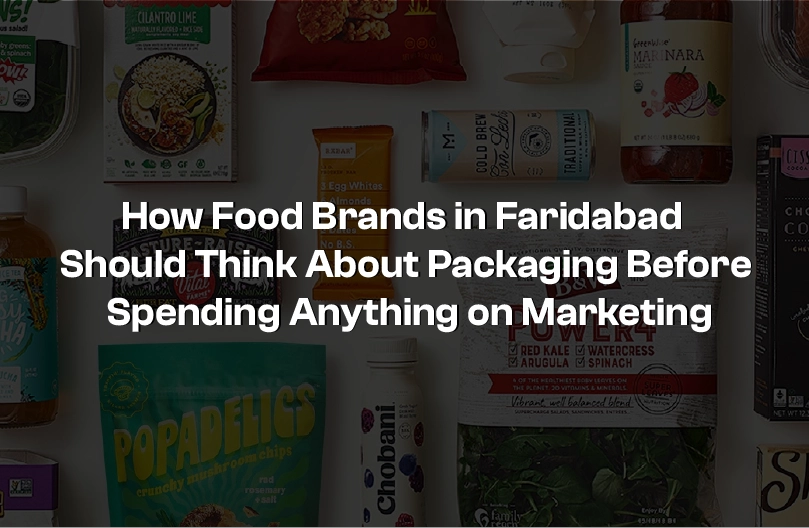
Most food brands in Faridabad get the order wrong. They build the product, they print whatever packaging feels right, and then they spend ₹40,000 a month on Instagram ads only to find that the ads bring people to a product that doesn’t convert at the shelf or on screen.
| Food packaging design is not a finishing touch. It is the first salesperson your product will ever have and in Faridabad’s growing food and FMCG market, it is often the only one working 24 hours a day. This guide covers what packaging actually needs to do, what FSSAI legally requires, what professional packaging realistically costs, and how the design requirements differ by channel. If you’re about to spend money on marketing, read this first. |
What Does Good Food Packaging Actually Do?
Food packaging does three distinct jobs, and most brands only think about one of them.
Job 1: It stops a stranger.
On a retail shelf, your product has roughly three seconds to earn a second look. That window is won or lost by colour blocking, a clear hierarchy of information, and a design that reads instantly from arm’s length. A survey of Indian consumers published in the Academy of Marketing Studies Journal found that approximately 90% of respondents said food packaging influenced their purchase decisions and the majority were willing to pay an 11–30% premium for a product that was better packaged. (Kapoor & Kumar, 2019, sample of 300 Indian consumers.)
Job 2: It builds trust.
Once the product is picked up, the label has to answer a set of silent questions: Is this brand real? Is this safe? Does it match the quality I’m expecting to pay for? A pack that looks amateur inconsistent fonts, a stretched logo, a missing FSSAI symbol — answers those questions in the wrong direction before the customer has read a single word.
Job 3: It stays legally compliant.
Under India’s Food Safety and Standards Act, 2006 and the Food Safety and Standards (Labelling and Display) Regulations, 2020, every pre-packaged food product sold in India must carry specific mandatory declarations. A pack that’s missing any of them exposes your business to a misbranding penalty of up to ₹3 lakh under Section 52 of the FSS Act confirmed by the Supreme Court in a 2024 ruling. More practically, it can get your product pulled from modern trade shelves on the spot.
Most packaging problems we see at First Branding Agency, our Faridabad-based branding and packaging design studio, come from brands that solved Job 1 and ignored Jobs 2 and 3.
What FSSAI Requires on Every Food Label in India
This is the section most packaging blogs skip. We’re not going to skip it, because it’s the section that saves you from a reprint six months after launch.
The Food Safety and Standards (Labelling and Display) Regulations, 2020 which replaced the older 2011 rules set nine mandatory declarations for every pre-packaged food product sold in India.
The 9 Mandatory FSSAI Label Declarations
| # | What’s Required | Key Detail |
| 1 | Name of the food | Must be standard or descriptive; non-misleading. “Fruit drink” if fruit content is under 10% you can’t call it “fruit juice.” |
| 2 | List of ingredients | In descending order by weight. Added water must be listed. Additives declared by functional class + INS number (e.g., “Preservative (INS 211)”). |
| 3 | Nutritional information | Per 100g/100ml AND per serving: energy (kcal), protein, carbohydrate (of which sugars), total fat (of which saturated and trans fat), and sodium. |
| 4 | Net quantity | In metric units (g, kg, ml, l). Minimum font size scales to pack size. |
| 5 | FSSAI logo + 14-digit licence number | In contrast colour. Must use the official FSSAI logo artwork not a recreation. Both brand-owner and manufacturer/packer licence numbers if different. |
| 6 | Veg / Non-veg symbol | Green symbol for vegetarian, brown for non-vegetarian. Products containing egg are classified non-vegetarian. Goes on the principal display panel near the product name. |
| 7 | Date marking | “Date of Manufacture/Packaging” + “Expiry/Use by.” Short shelf-life (≤3 months): day-month-year. Longer shelf-life: month-year. |
| 8 | Manufacturer / packer name and address | Full name and address. “Manufactured by X for Y” if contract-manufactured. Country of origin for imported products. |
| 9 | Allergen declarations | Eight major allergens must be declared: cereals containing gluten, crustaceans, eggs, fish, peanuts/groundnuts, soybeans, milk, and tree nuts. FSSAI permits symbol-based allergen depiction. |
Plus: a lot/batch/code number, and MRP and consumer care details as required under the Legal Metrology Act, 2009.
Small pack exemptions: Packages with a surface area under 100 cm² may omit the ingredients list, nutritional information, and additives declaration. Packages 30 cm² or smaller may print the manufacturing date on the outer carton.
What About Front-of-Pack Labelling (FOPL)?
FSSAI has been developing an Indian Nutrition Rating (INR) system a 0.5-to-5 star rating on the front panel reflecting a product’s overall nutritional profile. As of February 2026, this remains a draft regulation. The Supreme Court (a Bench of Justices J B Pardiwala and K V Viswanathan, order dated February 10, 2026) expressed concern about delays and directed FSSAI to respond within four weeks. No final gazette notification has been issued.
What this means practically: FOPL star ratings are not yet mandatory. But the regulatory direction is clear they likely will be, and they will change the front-panel real estate available to your brand. Design your pack with enough structural flexibility to accommodate a future front-panel nutrition graphic without a complete redesign.
The Biggest Packaging Mistakes Faridabad Food Brands Make
These are the patterns we see in briefs from food brands across Faridabad, Ballabhgarh, and Neharpar brands that have good products but are losing at the shelf or in the cart.
1. Information overload on the front panel
Trying to say everything at once produces a pack that says nothing clearly. The front panel has one job: stop someone and make them pick it up. The moment a founder says “we also need to fit the certifications, the tagline, the flavour variants, and the founder story on the front,” the pack is already over.
Rule of thumb: front panel = brand name, product name, hero visual, net weight, veg/non-veg symbol. Everything else goes on the back or side panel.
2. A logo that doesn’t scale
Most logos used on food packaging were originally designed for a business card or a social media profile. They were never tested at 8mm — which is the width your brand mark may appear at on a 50g spice sachet. A logo that works on Instagram but breaks at real print scale means your brand becomes invisible at the exact moment it matters.
3. No visual consistency across SKUs
Your mango flavour shouldn’t look like a different brand from your guava flavour. A consistent visual system using colour to differentiate variants while keeping the core brand identity intact — is what creates a shelf block. A shelf block is what makes your brand look like a brand rather than a collection of random products.
4. Compliance bolted on last
FSSAI symbols, the 14-digit licence number, and the veg/non-veg logo are frequently added after the design is “done” squeezed into corners, printed in the wrong colour, or at the wrong minimum size. This reads as amateur, erodes buyer trust, and is the most common reason food packs fail modern trade onboarding checks.
The right way: bring compliance requirements into the design brief at the start, not the end.
5. Designing for Instagram, not for the actual channel
A pack designed to look beautiful in a flat lay on a white background may perform poorly under the fluorescent lighting of a Faridabad wholesale market, or get crushed in a Blinkit courier bag. Packaging design must be tested against real conditions not just a screen.
Retail Shelf, D2C, and Quick Commerce: The Design Requirements Are Not the Same
This is where a lot of food startups in India make a strategic error. They design one pack and assume it works everywhere. It often doesn’t because the purchase environment is fundamentally different across channels.
| Channel | Primary Design Priority | Critical Factor |
| Retail shelf (kirana + modern trade) | Bold colour blocking, high contrast, product name readable at arm’s length, strong shelf block across SKUs | Wins a 3-second glance under store lighting. Modern trade = 52.8% of packaged food distribution in India (IMARC, 2025). |
| D2C and online-first | Premium unboxing experience, tactile finishes (matte laminate, spot UV), clear thumbnail at product-image size | The pack is the only physical brand touchpoint. Must survive courier transit and photograph well for social. |
| Quick commerce (Blinkit, Zepto, Instamart) | Pickable in under 15 seconds, weight-efficient, compression-resistant, clear in a small in-app thumbnail | Fastest-growing channel for Faridabad food brands. Fragile or heavy packs risk delisting. |
The smartest Faridabad food brands we work with build a dual-capability identity from day one a visual system that holds up in both a retail shelf block and a D2C product thumbnail, with structural choices that survive both courier and dark-store conditions.
What Does Professional Food Packaging Design Cost in India?
Pricing is the thing agencies don’t want to talk about. We will.
| Provider Tier | Typical Cost (per label/SKU) | What You Actually Get |
| Freelancer | ₹5,000–₹15,000 | A visual file. Usually no strategy, no compliance check, no print specs, no dielines. |
| Boutique design studio | ₹20,000–₹50,000 | Design with some strategy. Usually includes print-ready artwork. Compliance review may or may not be included ask explicitly. |
| Full-service branding agency | ₹40,000–₹1,00,000+ | Strategy, concept development, compliance integration, print-ready files (AI, PDF, dielines), Pantone specs, and a brand system that scales across SKUs. |
| Multi-SKU launch system | ₹1,50,000–₹5,00,000+ | The above, multiplied across a range, often with structural design, photography direction, and a brand guidelines document. |
A second SKU in the same range typically costs 30–40% of the first SKU’s cost. Additional variants run at 20–30%.
The honest framing: a ₹10,000 label and a ₹75,000 label are not the same product. The difference isn’t aesthetics it’s whether the pack was designed to pass modern trade onboarding requirements, survive a courier network, and carry a brand identity that compounds over five years rather than requiring a full reprint after twelve months.
When we design packaging design services for food brands at First Branding Agency, the process always starts with the channel brief, not the design brief because a pack designed for the wrong channel is an expensive mistake regardless of how good it looks.
The Right Order: Packaging Before Marketing
Here’s the practical argument, stated directly.
Marketing spend whether Meta ads, influencer campaigns, or Google Shopping drives a stranger to your product. What happens when they arrive is entirely determined by your packaging and brand identity. If the pack looks untrustworthy, if the product name is illegible at thumbnail size, if the veg symbol is missing, or if there’s no consistent visual identity linking your brand to your product the ad spend is wasted.
| A ₹40,000/month ad budget driving traffic to a ₹5,000 label is a guaranteed loss. The ads surface demand. The pack closes the sale or doesn’t. |
The sequence for any Faridabad food brand should be:
- Get the product formulation and positioning right.
- Build a compliant, channel-appropriate packaging design.
- Test the pack in your actual sales environment — market stall, modern trade shelf, product page photo, or dark-store thumbnail — before committing to print.
- Then scale marketing.
First Branding Agency is a branding agency in Faridabad that works with food brands, D2C startups, and FMCG manufacturers across Delhi NCR. We design packaging that starts with compliance, channel context, and brand strategy — not with a font choice. If your food brand is heading toward a launch, a packaging reprint, or your first round of serious marketing spend, this is the conversation worth having before the spend, not after.
Frequently Asked Questions
What are the mandatory FSSAI requirements for food packaging in India?
Every pre-packaged food product sold in India must carry nine mandatory declarations under the Food Safety and Standards (Labelling and Display) Regulations, 2020: the name of the food, a full ingredients list (in descending order by weight, with additives declared by INS number), nutritional information per 100g and per serving, net quantity in metric units, the FSSAI logo and 14-digit licence number, a veg/non-veg symbol, date marking, manufacturer name and address, and allergen declarations for eight major allergens. Misbranding carries a penalty of up to ₹3 lakh under the FSS Act.
How much does food packaging design cost in Faridabad?
A professional single-SKU food label from a branding agency in Faridabad typically ranges from ₹20,000 to ₹1,00,000 depending on the scope of work — whether it includes structural design, compliance review, print-ready artwork, and brand guidelines. Freelancers charge ₹5,000–₹15,000 but typically deliver only a visual file without strategy or print specifications. A full multi-SKU launch system from a branding agency runs from ₹1,50,000 upward.
How is packaging design for D2C food brands different from retail packaging?
Retail packaging must win a 3-second glance on a physical shelf, prioritising high contrast, bold colour blocking, and legibility at arm’s length. D2C packaging must perform as a small product thumbnail on a phone screen, photograph well for social content, and survive courier transit. Quick-commerce packaging (Blinkit, Zepto) has an additional requirement: it must be pickable in under 15 seconds and withstand dark-store handling. These are different design briefs, and treating them as the same is a common and expensive mistake.
Can I use a freelancer to design food packaging for launch?
You can, but understand what you’re buying. A freelancer will typically deliver a visual file. They will usually not conduct a compliance review (FSSAI label declarations), provide print-ready files with correct dielines and Pantone specifications, or build a brand system that scales across SKUs. If you’re launching a single SKU for a low-volume test, a freelancer may be sufficient. If you’re entering modern trade, scaling D2C, or building a brand that will live on shelves for years, the cost of a wrong brief compounds quickly.
What is the veg/non-veg symbol requirement for food packaging in India?
The Food Safety and Standards (Labelling and Display) Regulations, 2020 require a green filled circle inside a square for vegetarian products and a brown filled triangle inside a square for non-vegetarian products. It must appear on the principal display panel, near the product name, in a clearly visible size. Products containing eggs are classified as non-vegetarian under Indian law. The symbol must match the FSSAI-specified colours — not designer approximations.
Does packaging design affect sales for Indian food brands?
Research published in the Academy of Marketing Studies Journal (Kapoor & Kumar, 2019, 300 Indian consumers) found approximately 90% of respondents said food packaging influenced their purchase decisions, and a majority were willing to pay an 11–30% price premium for better-packaged products. A separate study in Ushus – Journal of Business Management (Saraniya et al., 2020) found 83.7% of Indian respondents agreed colour influenced them when buying a new product. Packaging is not a cosmetic decision for food brands it is a direct commercial lever.
Ready to Build Packaging That Actually Sells?
First Branding Agency is a branding and packaging design studio based in Faridabad, working with food brands, D2C startups, and FMCG manufacturers across Delhi NCR and pan-India. Our packaging projects start with a channel brief and a compliance review not a mood board. If you’re launching a food product or rethinking a pack that isn’t converting, get in touch before you spend anything on ads.
